
Jet Lag With Littles: How Do We Manage It?
Jet lag is one of those things that can sound especially intimidating when you start thinking about taking a little one on a big international trip. What if they're awake all night? What if they're miserable for days? What if you've flown halfway around the world only to spend the first half of your vacation trying to get everyone onto the right schedule?
We've crossed plenty of time zones with our son - Europe, the South Pacific and, most dramatically, an 11-hour time difference in Taiwan. And while that first day can definitely be rough, we've found that he usually adjusts surprisingly quickly.
Our approach isn't particularly scientific. We don't start shifting bedtime a week before we leave, and we don't have a carefully calculated schedule for when he should sleep on the plane. We mostly give ourselves some grace on travel day, start following local time once we arrive and trust that he'll get there.
So far, he always has.
Do We Adjust His Schedule Before We Leave?
Nope.
There are apps and strategies designed to help travelers adjust to a major time change before a trip - changing when you sleep, controlling light exposure or moving bedtime in the days leading up to departure. And those might be great tools for adults.
But we've never tried to shift our son's schedule before a trip.
Bedtime can be enough of a negotiation when we're asking him to go to sleep at his normal bedtime. Trying to convince him that he needs to fall asleep an hour earlier because we'll be in another time zone several days from now doesn't sound particularly promising.
Instead, we'd rather have him start the trip as well rested as possible. If we can get him into bed a little early the night before? Even better - although sometimes that's as much about giving us a little extra time to finish packing and get ourselves to bed too!
What About Sleep on the Plane?
Travel day is different, and we treat it that way.
My husband and I might look at the destination time and make a conscious effort to get ourselves onto the new schedule. We might force ourselves to stay awake for a few more hours or put on an eye mask, turn on white noise and try to convince ourselves that it's bedtime.
We don't expect our son to do the same.
If he's tired, we let him sleep. If he's wide awake when we'd really prefer that he sleep, we don't spend hours trying to force it.
Because realistically, that's probably a losing battle anyway.
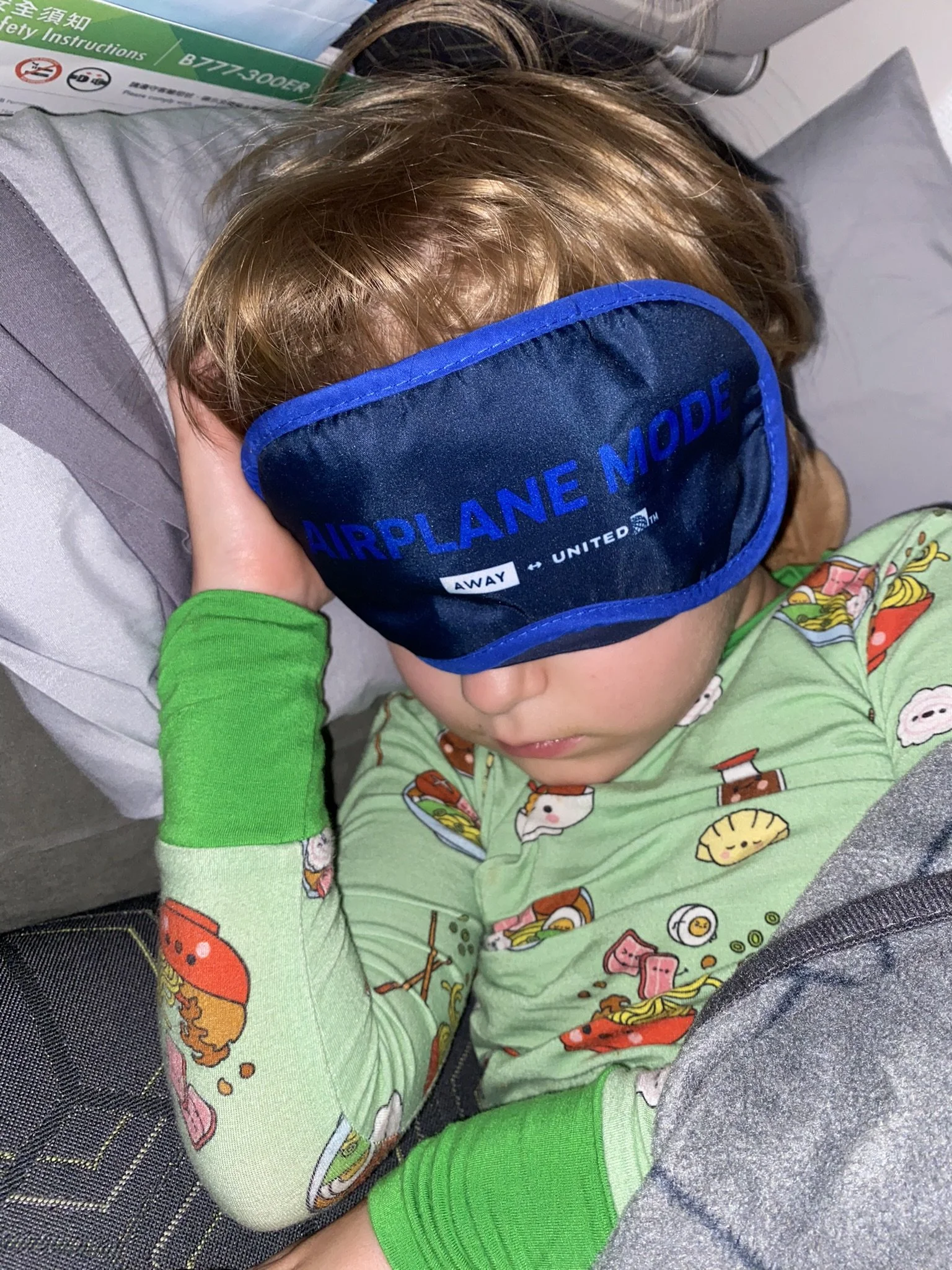
Trying to keep an exhausted child awake can turn a sleepy kid into a very cranky sleepy kid. Trying to make a child sleep when he's nowhere near ready can be just as frustrating for everyone involved.
And honestly, if your child voluntarily falls asleep on an airplane, are you really going to stop him?
We certainly aren't.
Our approach: Travel day gets a pass. We encourage sleep on the plane, but we don't try to micromanage exactly when it happens. Once we arrive, that's when we start paying much more attention to the local clock.
Once We Arrive, We Start Following Local Time
Once we're actually at our destination, we try to start following the local schedule pretty quickly.
If we arrive during the day, we try to stay awake and start behaving as though we're already on local time. We eat when people there are eating. We get out of the hotel. We explore. We start doing whatever we came all that way to do.
That doesn't mean we schedule an elaborate itinerary for arrival day.
When we arrived in Taipei, for example, we got there early enough that our hotel room wasn't ready - something we'd anticipated. We left our luggage with the concierge and headed over to Taipei 101 for a while.
Were we tired? Absolutely. But it gave us something to do, got us out into the city and helped fill those strange first few hours when your body has absolutely no idea what time it is.
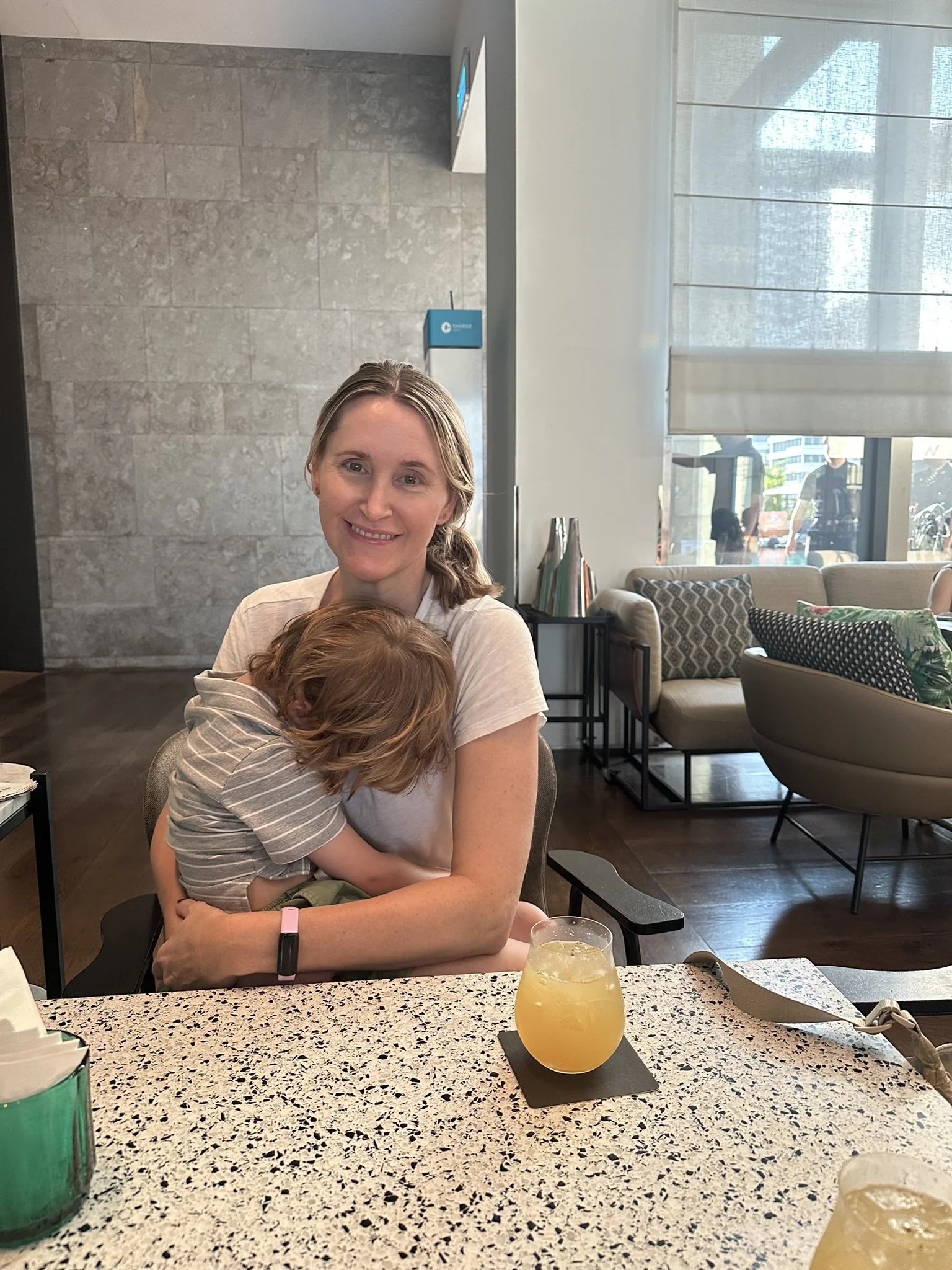
Eventually we went back to the hotel, where our room still wasn't quite ready. So we relaxed in the main dining area with a couple of drinks and waited. Later, we tried to make it through cocktail hour, but by then our son had passed out in the restaurant area and the rest of us weren't doing much better.
We called it a day and went to bed early.
And that was perfectly fine.
Sometimes You Just Have to Admit Defeat
Taipei wasn't the only time we've tried to power through and eventually realized it wasn't happening.
One evening in Budapest, we were attempting to stay awake through dinner. Our son had already fallen asleep in his stroller, and at some point I fell asleep sitting at the table, leaning against the wall.
Eventually my husband woke me up and we collectively acknowledged the obvious: nobody needed to prove anything here.
We went back to the hotel and went to bed.
That's really our philosophy for the first day. We try to get onto local time. We get out, stay active and make it as far into the day as we reasonably can.
But there isn't a prize for keeping an exhausted family awake until an arbitrary bedtime.
Sometimes sleep wins.
What If He Falls Asleep While We're Out?
We let him.
This is one of the reasons we love having a travel stroller with us. If we're out exploring and he hits a wall, he doesn't necessarily need to make it all the way back to the hotel before he can sleep. He can nap while we keep moving.
Is an afternoon stroller nap always going to be the perfect thing for getting onto a new time zone? Maybe not. But we're also not interested in spending an hour battling an exhausted child in the middle of a vacation because we're afraid a nap might interfere with bedtime.
If he needs it, he needs it.
What About the Dreaded Early Wake-Up?
We've actually been pretty lucky here. Our son hasn't regularly decided that 2 a.m. is morning after a major time change…I'm usually the bigger problem!
He might wake up earlier than we'd prefer - 6 a.m. on vacation isn't exactly my idea of sleeping in - and we'll sometimes try to snuggle for a while and see if he'll fall back asleep.
But if it's obvious he's awake for the day, we generally embrace it. An early start isn't necessarily a terrible thing while traveling, and it can make an earlier bedtime that evening much easier.
If it's really early? Our standards become a little more flexible.
Mommy and Daddy still want to sleep. If letting him watch his iPad quietly buys everybody a little more time in bed, that's a rule we're willing to bend.
And honestly, our son isn't always the one struggling the most with the time change. When my husband and I were in Tokyo on our honeymoon, I woke up around 3 a.m. After lying there for about 30 minutes and realizing I wasn't going back to sleep, I gave up and went to the hotel gym.
There is something oddly satisfying about having an entire hotel gym to yourself at 3:45 in the morning.
It's also not an experience I want to recreate on each vacation, though!
Do We Keep the First Few Days of the Trip Light?
The arrival day? Yes. The next day? Not necessarily.
We generally don't schedule much for the day we fly in because there are simply too many variables. Maybe everyone will feel great. Maybe the room won't be ready. Maybe somebody will desperately need a nap. Maybe you'll make it through dinner. Maybe you'll fall asleep against a wall in a Budapest restaurant.
Have some ideas for how you might spend those first few hours, but be willing to change them.
Once the official Day 1 of the actual vacation arrives, though, we don't want to lose days worrying about jet lag that may or may not happen.
We've scheduled private tours for the morning after arriving in a new city before, and I actually like doing that. A good tour early in a trip helps us get acquainted with the city, answer some of our initial questions and knock out a few of our must-sees.
We may just be thoughtful about the start time based on when we arrived the previous day.
Kids May Surprise You
Our son's biggest time change so far was Taiwan - 11 hours ahead of home.
By Day 2, he was functioning just fine and participating in everything we'd planned.
We've seen essentially the same thing at different ages too. As a baby, toddler and now an older preschooler, the pattern has generally been pretty similar: sleep eventually wins on that first day, and then he starts adapting.
That doesn't mean your child won't be tired. They might be cranky. They might fall asleep in the stroller. Dinner might happen earlier than you planned.
But we've traveled with him across all kinds of time changes, and jet lag has never disrupted several days of our vacation.
So, Are We Worried About Jet Lag?
Not really. We know that first day might be rough. We know one of us might be fighting to stay awake through dinner. We know our son might decide he's done long before we are.
We just don't build the trip around worrying about it.
We let travel day be travel day. We try to follow local time once we arrive. We get outside and start exploring when we can. We let him sleep when he truly needs to sleep. And if everyone hits a wall earlier than planned, we call it a day and try again tomorrow.
If jet lag is one of the things making you nervous about taking a little one on a big international trip, give yourself some flexibility - but don't automatically assume it's going to cost you half your vacation.
Kids can be remarkably adaptable. Sometimes, they're adjusting just fine while you're the one awake at 3:45 a.m.!
A Little Flexibility Goes a Long WayJet lag with a little one doesn't have to mean losing the first several days of your trip. Give yourself some flexibility on travel and arrival day, have a few ideas for what you could do without committing to a packed schedule, and start following the local time once you're there.
If your child needs to sleep, let them sleep. If everyone hits a wall earlier than planned, call it a night. In our experience, kids can adapt surprisingly quickly - even with a major time change.
Give yourself some breathing room, don't try to perfectly control everyone's sleep, and remember: tomorrow is a new day!

Last updated: September 2026